
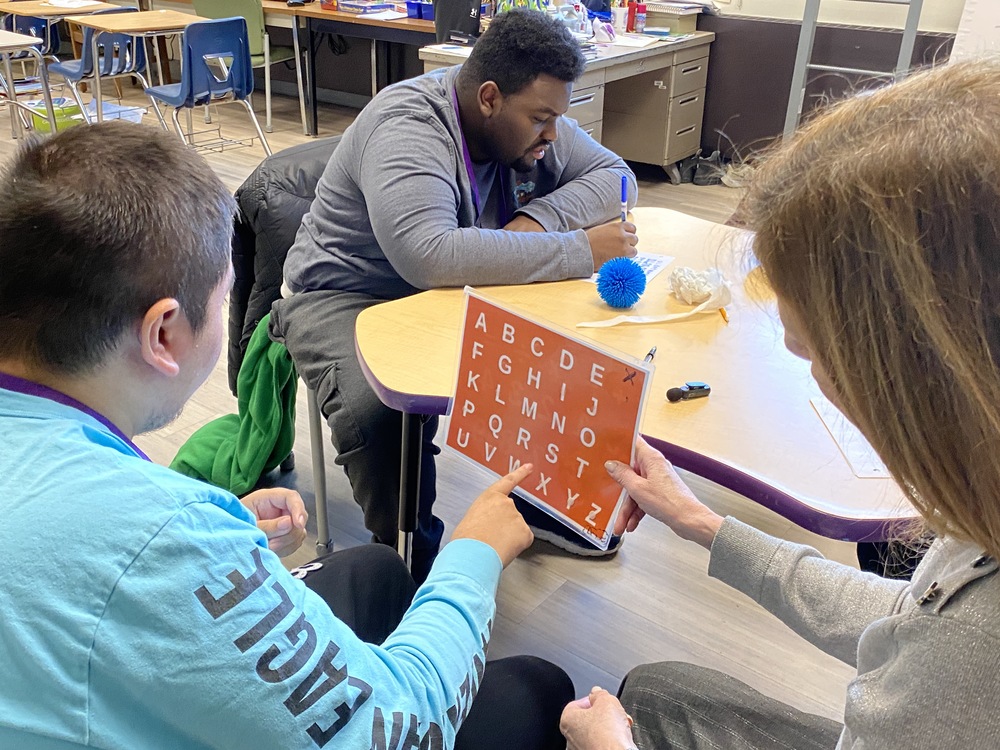
It looks like a simple, laminated board with letters on one side and numbers on the other. But it is the instrument Erik uses to share his thoughts, ideas, and preferences, which his Mom had never heard until high school Foundations special education teacher Cynthia Milite introduced him to Spell to Communicate, or S2C.
Milite became S2C certified on her own to help non-speaking students communicate. In the classroom, Milite holds a letterboard while students point to letters to spell. She has been using this method for the past two years so that the students can contribute to class discussions, answer questions, and voice their opinions.
Erik Lopez-Torres and former classmate Tai Johnson use S2C to overcome apraxia, a motor planning disorder in which the brain and body are not in sync. Both were eager to share their stories.
“Spelling to communicate has changed my life,” said Erik via S2C. “Before I lived in silence. And no one gave me a chance to show them how smart I really am.”
Tai, who had been in the program for seven years but aged out earlier this month to an adult placement, shared his frustration at living with apraxia. “Nobody sees what hell it is on the inside,” he said. “You really need to experience the turmoil that this creates.”
Teacher’s aide Ron Oliver faithfully transcribes communication from both students. They describe him as an important and loving figure in their lives.
The American Speech-Language-Hearing Association advises against using S2C on the grounds that there is a lack of scientific evidence to prove its validity and concerns about message authorship. Milite makes the method available to students whose families want it.
Milite said some students prefer S2C over other augmentative and alternative (AAC) methods such as iPads, which they find clunkier and slower to use.
During a recent visit to Milite’s classroom, Erik and Tai used S2C to discuss their role model, Einstein, and talked about their interests, which include literature and poetry. Erik, who participates in mainstream English classes, said he hoped to earn his GED and go to college to study mathematics.
Mom Paola said, “I always knew he was smart. S2C has unlocked the barrier to communication. He is bilingual. He just read ‘Animal Farm,’ ‘Of Mice and Men,’ ‘Kite Runner,’ ‘Lord of the Flies,’ and ‘Romeo and Juliet.’ He loves museums and Indian music.”
With Tai’s departure from the high school, Erik is now the only student using S2C until his graduation in May. Milite said she hoped to introduce the method to other minimally communicative and non-speaking students.
“Non-speakers have been underestimated and misunderstood most of their lives,” she said. “Spelling to communicate allows students to have their voices heard finally.”